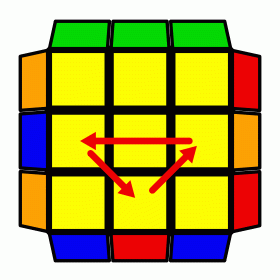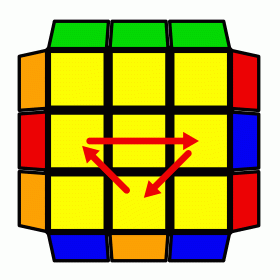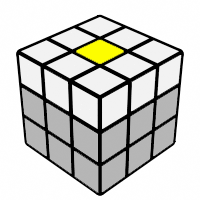
OLL Dot Cases (##1, 2)

dot2_200pxSo, yeah, I’m still cross training, although I don’t expect to harvest any significant improvement for a while. In the meanwhile, I decided to learn a couple more OLLs that seem to crop up frequently — the single dot cases. The two cases (OLLs ##1 and 2 on the speedsolving.com wiki) are mathematically somewhat rare — with their probabilities at 1/108 and 1/54 respectively. That’s the equivalent of a 1-in-36 (or about a 2.8%) chance of having either of these cases arise during a solve. They seem to occur more frequently for me, probably just because not knowing how to one-look them made them more conspicuous.

I don’t usually post about each OLL or PLL I learn. But there seemed to be a dearth of tutorials on these two cases, with the few videos I found online lacking any technique focus or finger-trick explanations. Also, both of these OLLs seemed vulnerable to simplifying alternations to make them more accessible to beginners or novices. Here’s my short video tutorial:
(music: Jacob Fred Jazz Odyssey, “Thelonious Monk is My Grandmother”; cube: Lubix Zhanchi w/ Cube Specialists fitted bright stickers and modded Cubesmith grey stickers for U face)

Continue reading

Cross Training

It’s time to come clean: My cross skills suck.

It’s been 14 months since I wrote about more advanced cross techniques, which is only slightly less long than I’ve been at this cubing thing altogether. At the time, I was thrilled just to move on from the beginner’s method of forming a daisy on top. Memorizing the cube’s color scheme seemed like an accomplishment.

A year-plus later, I’m stuck at around 35 seconds. I’ve learned all 21 PLLs, have gotten pretty fast at two-look OLL (with a handful of OLLs one-lookable), and am competent with F2L (fast, but with lots of hunting still). But my crosses are still really clunky. Time to start focusing on the cross.

To set a benchmark, I did 5 Ao12s of just crosses. I spread out the sessions to make sure they were pretty accurate representations. Although there are a few stray bests, the 60-cross average was 6.75: Continue reading

Clearly Zhanchi

clear-zhanchiI discovered a couple months ago on the speedsolving.com forum that Dayan made a small run of Zhanchis in clear plastic around April 2011. They were prototypes, and only about 100 were made. A few vending sites, such as 51morefun.com and lightake.com list them, but as sold-out at this point. Given the rarity, they’ve been hawked on Ebay for over $800!?!

I’ve always dug clear products. Getting to see the inner-workings of intricate machines is fascinating. So, the chance of getting my favorite puzzle in a translucent model was intriguing. The rarity of it made it that much more so. But I wasn’t going to drop 8 Franklins for what is otherwise a $12 puzzle!?!

I eventually found someone on the speedsolving.com forum who was willing to part with a new DIY kit at a reasonable price. I received it a couple weeks ago and finally got a chance to assemble it. Here’s a video:

Continue reading

DIY Panshi — FAIL!

video-setupI had grand plans for this post. I figured I’d say how excited I was to get the new DaYan Panshi DIY kit; that I put together a highly sped-up video of me assembling, lubing, tensioning, and stickering it; that it’s a very good cube but not necessarily better than a Zhanchi or Guhong v2; yadda yadda yadda. My posts are always so verbose; for once, I figured, this one could be video-driven.

Well, things didn’t quite work out as expected.

I did setup my video camera and assembled the Panshi as planned. And the resulting video is below. But instead of ending by showing H and F and U perm executions on a new cube, it ends with a 42mm Zhanchi sacrificed for its (now-ruined) core and a defunct Panshi with a broken core, four broken torpedoes, and one broken corner stem. All the result of a badly-made screw.

(music: String Cheese Incident performing “Galactic” on 7.30.03)

What happened? Continue reading

U Perms (Revisited)

Slow-Motion videos of these algorithms are available here.

U Perms. Round 3. I sort of accidentally learned the U Perm (edge cycling) through the Beginner’s Method and its clunky final algorithm: F2 U(’) R’ L F2 R L’ U(’) F2. Then I started learning PLLs and wrote about the more efficient approaches I had found (now-stricken in the table below). When I did my foozled PLL time attack, that Ua was my fastest with Ub second. But those still involved a lot of moves, and Ub had a sort of clunky flow.

When I learned double M flicks, I started doing Ua with the new M/U algorithm. But I couldn’t get Ub figured out, with my hands mis-positioned for the U’ turns. Then I stumbled onto Anotine Cantin’s video on how to fingertrick Ub. A little awkward at first with the right index finger pulling left to right for U’, but it wound up being pretty easy after a little practice. Here’s my video showing both:

Once I got the finger-tricks figured out, these wound up having a really nice flow. And, in contrast to the older versions, there’s an elegant symmetry to the clockwise and counter-clockwise algorithms.

U PERM (Edge Cycle)

Ua PLL
Counter-Clockwise

M2 U M U2 M’ U M2

(R U’ R U) (R U) (R U’) (R’ U’ R2)

Ub PLL
Clockwise

M2 U’ M U2 M’ U’ M2

(R2 U) (R U R’ U’) (R’ U’) (R’ U R’)

Onward….