Y Perm (OLL 37 + OLL 33)

Over the past month, my F2L speed has increased considerably — now averaging about 20-22 seconds…and dropping. My cross can get faster, but it’s not terrible at 6-ish seconds.

That leaves the last layer as the big x-factor. I know a handful of OLLs and PLLs. Still, I’m two-looking the orientation stage and then two-(and-sometimes-even-three-)looking the permutation stage.

I haven’t tried to pick up new algorithms for a while, mostly because I feel like I’ve already picked the low hanging fruit. (A glutton for punishment, I did recently learn Na Perm but then stalled at the tougher Nb.)
Continue reading

road trip: F2L revisited

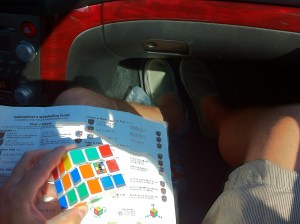
Just back from a family road trip. I found myself in the passenger seat for the first and last 8-hour legs — the car seat behind it makes the legroom too small for my wife to sit there comfortably. Boredom. Good thing I brought a cube and Andy Klise’s awesome cheat sheet summarizing Badmephisto’s F2L algorithms.

Learn F2L intuitively. Those seem to be the F2L watchwords. And so I did. Intuitively. The basic idea of setting up pairs in the top layer and then inserting them into a slot made sense. And the basic approaches for hiding a corner while moving an edge eventually became second nature. But not efficient. With half the edge/corner pairs (on average) in the front/left faces, I had to do the exceptionally awkward (F’ U’ F) trigger to get them into the front-right slot or do a y turn to get the pair into the left/back faces for a (L’ U L) trigger. Either way, I’d have to slow down, switch hands, re-position, etc. No surprise, my fastest solves are the ones with all or most of the insertions resulting from pairs in the right/front faces with the super easy (R U R’) trigger. Continue reading

3×3 Walk-Through Solves (via CrazyBadCuber)

Over the past week, I’ve spent a little more time than usual on youtube. There’s a lot of good stuff out there, but even more junk. Of all the videos/channels I’ve visited, I’ve been most impressed with CrazyBadCuber‘s. In particular, I found this 3×3 walk-through video to be enormously helpful (especially for F2L look-ahead/tracking):

As someone averaging around 45 seconds with a personal best of 34, this narrated play-by-play helped me identify all sorts of inefficiencies in my current technique — and encouraged me to slow down and practice better techniques.

P.S. Notice the new domain? No more “.wordpress.” in there. For a mere $18/year, I figured it was time to (pretend to) do this for real….

PLL corner cycles (A Perm)

As I earlier posted, I’ve been learning OLLs and PLLs at a moderate pace, trying to move past the inefficiencies of the Beginner’s Method. About half-way through learning A Perm, a light bulb went off: It corner cycles the same way as the penultimate Beginner’s Method algorithm of R’ F R’ B2 R F’ R’ B2 R2 — with Aa as the far less re-grippy surrogate, and Ab (its mirror) more efficient than serial application of the Beginner’s Method algorithm. (Slowly, it’s all coming together….)

I find the A Perm one of the easier cases to recognize, with its characteristic 2x2x1 block in a top-layer corner, the block having matching colors on either side. I set up by AUF‘ing the 2x2x1 block into the front-left corner, with the 2×2 block matching the middle and bottom layers (as in the diagram to the right). If the headlights (green-xx-green in the below diagrams) are in the back, you do the Aa Perm; if the headlights are to the right, you do the Ab Perm.

A Perm (Corner Cycle)

Aa PLL(CLOCKWISE)

(Lw’ U R’) D2(R U’ R’) D2 (R Lw)

Ab PLL(COUNTER-CLOCKWISE)

(Lw’ R’) D2 (R U R’) D2 (R U’ Lw)

Continue reading

PLL edge cycles (U Perm)

UPDATE: I’ve replaced this set of algs with M-slice versions.

Over the past couple months, I’ve tried to exorcise all remnants of the Beginner’s Method. F2L replaced the corner-first/edge-next approach a while ago, and several OLLs have made top-layer orientation a (generally) single-algorithm affair. But my PLLs were still a bit all over the place. I got to the two-look stage pretty easily (with no illusions about being able to one-look it for a while still), but realized that I was still using the Beginner’s Method algorithm for edge cycling — to wit, F2 U(’) R’ L F2 R L’ U(’) F2. Although I got freakishly quick at that algorithm, it required all sorts of awkward hand movements and lent itself to no finger tricks.

Since almost every one of my solves requires an edge cycle — with H and Z perms or the rare PLL skip as the lone exceptions — this bull-in-a-china-shop algorithm had to go. Enter the U perm:

U Perm (Edge Cycles)

Ua PLL(COUNTER-CLOCKWISE)

(R U’ R U) (R U)(R U’) (R’ U’ R2)

Ub PLL(CLOCKWISE)

(R2 U) (R U R’ U’)(R’ U’) (R’ U R’)

Continue reading