PLL Time Attack (72 seconds)

It’s been a little while since I felt like I’ve accomplished much in terms of cubing, especially after plateauing at about 30-35 seconds on 3×3 solves. So, I decided to revisit PLL time attacks, and, after a few days of practice, got a good outcome: an on-camera 72-second PLL attack that started and ended with a solved cube:

(music: Dexter Gordon, “Scrapple from the Apple”; cube: Zhanchi w/ ModCuber fitted full-bright stickers)

By way of brief background, PLL is the last step in CFOP — once you have a solved bottom face, solved bottom two layers, and solved top face. All that’s left is to get those four edges and four corners in the top layer rejiggered into their proper position. There are 21 PLL cases (22 if you count solved), each named after a letter that somewhat resembles the pattern of the edge and corner swaps. More detailed background and the PLL algorithms can be found on the speedsolving.com wiki.

A PLL time attack is the performance of each of the 21 PLLs in a stream without stopping. Completing it in a minute is respectable, but not amazing; forty-five seconds is really good; and better than that is truly impressive. When I first learned PLLs, I did a quasi time attack — quasi because it was truncated (I did the Gs separately), because I did each PLL individually (not in a single stream), and because I used my best of three attempts per PLL. The sum of the 21 parts was 66 seconds. Continue reading

AL60 Solve Response – 35 seconds (Arghhhh!)

Yesterday, AL60Ri7HMi57 posted a quick video with new lighting and a clean 22-second solve. In the comments, she wrote, “Do the scramble and post your time in the comments below!” So, I figured I’d give it a shot. I had my camcorder charging on my desk, so I haphazardly aimed it, flipped it on, scrambled, and solved. 35.65 seconds. Not great. But, in all honesty, right about where I am. At least on video. I’m about 5-7 seconds faster off video, without the inexplicable nervousness of being on-cam.

The Video and Initial Observations

My first reaction was to ignore the solve and move on. Rarely one to miss an opportunity for self-examination, though, I decided to learn from it. So, for better or worse, here’s the video.

(music: String Cheese Incident, ¡Bam! (March 23, 2002); cube: black Zhanchi w/ Cube Specialists fitted bright stickers and modded Cubesmith grey stickers for U face)

Continue reading

V Perm (Revisited)

v permI remember learning the V Perm early in my PLL progress and being quite proud of myself. I even wrote this dedicated post containing a video showing my unimpressively slow execution. Unfortunately, the execution never got that much more fluid. Although it was an average speed perm for me when I did my (kinda sorta) PLL attack, it always was one of my clunkier ones.

Last weekend, jskyler91 posted a new Cubing World video showing a “non-standard” V Perm execution based on this algorithm:

z D’ R2′ D (R2 U R’) D’ (R U’) (R U R’) D (R U’) z’

No awkward re-grips and much smoother than the traditional approach. He bemoaned the z rotations; I was intimidated by all the D layer moves. Still, the fact that he could sub-1 the perm led me to believe that I could do it in 2. As this video shows, I’m close:

(music: Eldar Djangirov interpreting “Cool” (West Side Story); cube: Lubix Zhanchi w/ Cube Specialists fitted bright stickers and modded Cubesmith grey stickers for U face)

Continue reading

OLL Dot Cases (##1, 2)

dot2_200pxSo, yeah, I’m still cross training, although I don’t expect to harvest any significant improvement for a while. In the meanwhile, I decided to learn a couple more OLLs that seem to crop up frequently — the single dot cases. The two cases (OLLs ##1 and 2 on the speedsolving.com wiki) are mathematically somewhat rare — with their probabilities at 1/108 and 1/54 respectively. That’s the equivalent of a 1-in-36 (or about a 2.8%) chance of having either of these cases arise during a solve. They seem to occur more frequently for me, probably just because not knowing how to one-look them made them more conspicuous.

I don’t usually post about each OLL or PLL I learn. But there seemed to be a dearth of tutorials on these two cases, with the few videos I found online lacking any technique focus or finger-trick explanations. Also, both of these OLLs seemed vulnerable to simplifying alternations to make them more accessible to beginners or novices. Here’s my short video tutorial:

(music: Jacob Fred Jazz Odyssey, “Thelonious Monk is My Grandmother”; cube: Lubix Zhanchi w/ Cube Specialists fitted bright stickers and modded Cubesmith grey stickers for U face)

Continue reading

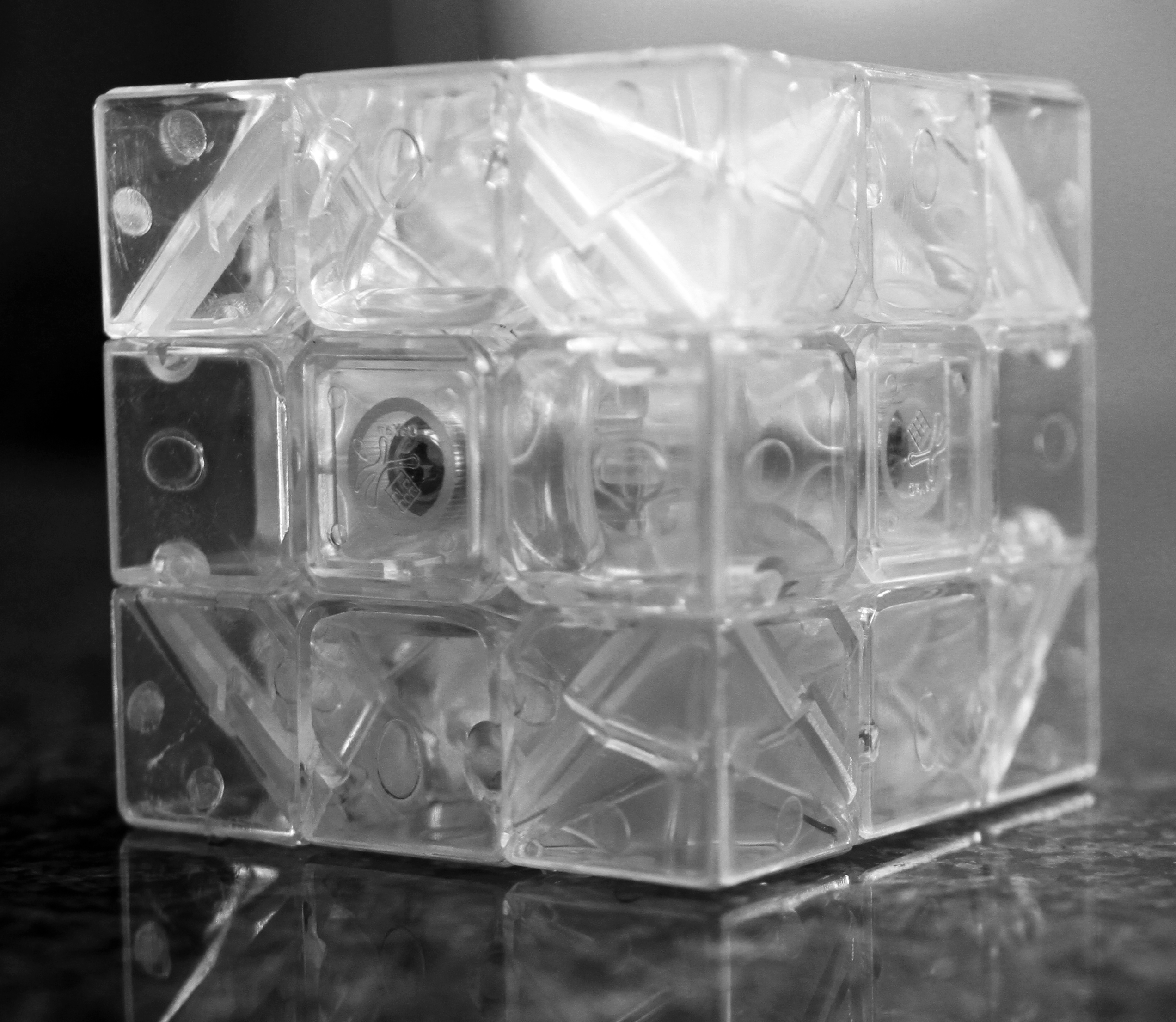
Clearly Zhanchi

clear-zhanchiI discovered a couple months ago on the speedsolving.com forum that Dayan made a small run of Zhanchis in clear plastic around April 2011. They were prototypes, and only about 100 were made. A few vending sites, such as 51morefun.com and lightake.com list them, but as sold-out at this point. Given the rarity, they’ve been hawked on Ebay for over $800!?!

I’ve always dug clear products. Getting to see the inner-workings of intricate machines is fascinating. So, the chance of getting my favorite puzzle in a translucent model was intriguing. The rarity of it made it that much more so. But I wasn’t going to drop 8 Franklins for what is otherwise a $12 puzzle!?!

I eventually found someone on the speedsolving.com forum who was willing to part with a new DIY kit at a reasonable price. I received it a couple weeks ago and finally got a chance to assemble it. Here’s a video:

Continue reading