
Another new personal best. 41 seconds. Beastie Boys’ “So What’cha Want?” remix/mashup with Cypress Hill played in the background.
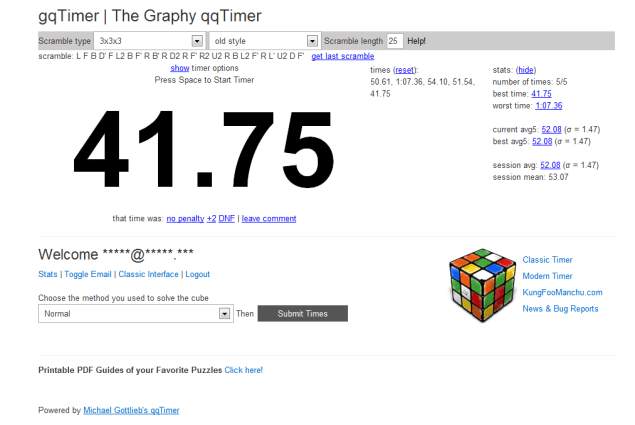
Another new personal best. 41 seconds. Beastie Boys’ “So What’cha Want?” remix/mashup with Cypress Hill played in the background.
New personal best. 42 seconds. w00t!

Bill Evans’ “Five” played in the background.
P.S. I really dig the gqTimer (Graphy qqTimer) I’ve been using lately. It stores your times (using your Google login) and logs them into graphs. Great timer — and now my go-to instead of Cube Timer.
Just got a new 3×3 personal best (non-lucky) solve: 46 seconds.
Only a half-second better than my last best time, but it definitely felt smooth and easy. I’m starting to believe the much-preached truth that consistent, slower turning is better than rushed turns punctuated by long delays of hunting for pieces. I was excited to encounter and easily apply a newly-learned OLL (#22) during the solve.
This was with my black Dayan Zhanchi (favorite cube, by far), restickered with a Cubesmith bright-set. The very excellent new Big Gigantic album played in the background.
 I feel like I’m starting to hit a new groove. After mastering the Beginner’s Method a couple months ago, I’ve slowly embraced more complicated techniques (read: time-savers). First, it was the advanced cross technique, which I learned quickly but at which I’m still slower than I ought to be. Then it was a month of intuitive F2L. I’ve got that mostly down, with a couple non-intuitive cases still a challenge. Lately, I’ve been jazzed to learn a few more OLL/PLL algorithms. Each expands the toolbox and introduces more efficiency. Last week, it was H and Z PLL perms. This week, it’s OLL 6 (aka, The Sidewinder).
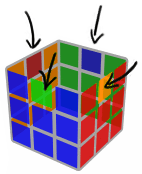 A few days ago, Deadesq (AIC’s first guest blogger) mentioned to me that he was looking for a more efficient solution to the four-headlight situation. By four headlights, he meant the situation in which, after applying the Beginner’s Method PLL corner permutations, you’re left with all four faces having headlights — with no fully solved side face. As I described in my tutorial, in that situation, the Beginner’s Method requires applying the PLL edge permutation algorithm twice in a row. Although I can do that quickly, it’s still not as quick as a single permutation. Enter H and Z perms…. Continue reading
 adventures in cubing