F2L Edge Flip

I just posted last week about some fancy edge insertion techniques I had learned. With those down, I realized that I was missing a good algorithm for addressing edges placed in the correct F2L slot but flipped. I finally came across this one, which works fantastically:

r (R U R’ U’) r’ U2 (R U R U’ R2)

I’ve got it down to about 2 seconds now, as shown in this quick video:

(music: Umphrey’s McGee covering Peter Gabriel’s “Sledgehammer”)

I previously had used (R U’ R’) d (R’ U2 R) U2′ (R’ U R) for edge flips. Continue reading
Tricked-Out F2L Edge Inserts (Hello, S Moves!)

It’s been a few weeks now since I posted my PLL attack video. It’s not that I’ve been cubing less, but just that I haven’t had a lot of time for documenting things. A particularly busy month at work and family stuff — including a couple great birthday celebrations for my boys — evaporated my free time.

As of my last post, I had learned all PLLs minus the Gs. Since then, I’ve learned Ga well and Gb poorly. The two being inverses, I’m now able to practice them more fluidly.

I also stumbled onto and subscribed to TellerWest’s Youtube channel, featuring some really great “tricked out” algorithms that are far faster and more efficient (for the more advanced and dexterous of cubers). This particular F2L video caught my eye, since F2L edge inserts have been especially slow for me. (Edge inserts are when a corner is properly placed, but the edge is in the top layer.) After watching a few times, I realized that they weren’t the longest or hardest algorithms. So I gave them a try — and, in so doing, encountered my first S slice.

Continue reading

road trip: F2L revisited

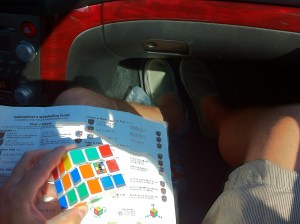
Just back from a family road trip. I found myself in the passenger seat for the first and last 8-hour legs — the car seat behind it makes the legroom too small for my wife to sit there comfortably. Boredom. Good thing I brought a cube and Andy Klise’s awesome cheat sheet summarizing Badmephisto’s F2L algorithms.

Learn F2L intuitively. Those seem to be the F2L watchwords. And so I did. Intuitively. The basic idea of setting up pairs in the top layer and then inserting them into a slot made sense. And the basic approaches for hiding a corner while moving an edge eventually became second nature. But not efficient. With half the edge/corner pairs (on average) in the front/left faces, I had to do the exceptionally awkward (F’ U’ F) trigger to get them into the front-right slot or do a y turn to get the pair into the left/back faces for a (L’ U L) trigger. Either way, I’d have to slow down, switch hands, re-position, etc. No surprise, my fastest solves are the ones with all or most of the insertions resulting from pairs in the right/front faces with the super easy (R U R’) trigger. Continue reading

39 seconds (on camera)

Over the past few weeks, I’ve posted a series of personal bests — culminating in last week’s 34 second solve.  But none of those PBs were evidenced by anything other than a screen capture.  So, it was nice just now to record (on my hastily set up iPad) this 39-second solve before diving into my work day.

This was on my re-stickered Dayan Zhanchi, with my custom (homemade) G‑sticker.  This nicely showcases my slow but steady evolution — with no remnants of the Beginner’s Method. Advanced cross, F2L, Antisune (OLL 26), and the just-learned Ub Perm for the PLL edge cycle.

Tough F2L Cases

PSA: This is a very old post, written just as I had begun to tackle F2L. Although my F2L is now much better, these cases remain hard. I’ve addressed these cases a few times since, with more robust analysis and improved algs — e.g., here, here, and here.

So, I’ve been working hard on F2L. Refusing to memorize algorithms, and heeding expert advice, I’ve concentrated on learning it “intuitively” or “organically.” While most of the cases feel instinctive at this point, there are a handful whose solution feels slightly less intuitive. This tutorial is a sort of personal dumping ground and cheat sheet for the cases I find toughest. I’ll add cases as they come up for me.

The basic solutions come from Badmephisto’s F2L cheat sheet, with some small tweaks to personalize them into my solving technique. As always, the visual diagrams come from Conrad Rider’s fantastic Visual Cube generator. Continue reading