
‘Twas another beautiful Southern California weekend with many an hour of relaxing in and by the pool. With a nice Punch stogie, Grateful Dead (2/14/68) on the hi-fi, and some new “dot” OLLs in the mix. Another dot OLL video coming soon....

 A friend and I have a unspoken tradition of buying gag gifts for each other off our Amazon wish-lists, which amounts to us placing a bunch of random stuff on the lists to see what the other orders. Traditionally, it’s been music or movies, but we’ve definitely had some weird things come up — digital home thermostats, drill bits, and the like. Long ago, I placed a stickerless Dayan Megaminx (a dodecahedron shaped puzzle) on my list and forgot about it. I had no real interest in it, had no expectation of ever being able to solve it (I was a 2-minute 3×3 solver at the time), and, more than anything, thought it would be a funny item for the wishlist. Lo and behold, it arrived at my house last December. I messed with a few times, got frustrated, and stashed it on my shelf.
A couple days ago, my 19-month-old brought it over to me, having scrambled it on his way. My OCD thusly challenged, solve it I had to. Which meant learning how to solve it.
I approached it entirely intuitively after realizing through a couple web searches that it’s essentially a complicated 3×3 — with 12 faces (rather than six), each with 5 edges and 5 corners (rather than 4). I experimented a couple times and then, on my third, decided to give it a go on video. Here is the result — a 10-minute solve (excluding the last layer), presented at 3x speed: Continue reading
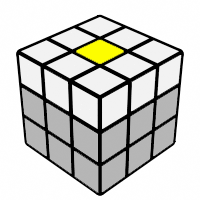 So, yeah, I’m still cross training, although I don’t expect to harvest any significant improvement for a while. In the meanwhile, I decided to learn a couple more OLLs that seem to crop up frequently — the single dot cases. The two cases (OLLs ##1 and 2 on the speedsolving.com wiki) are mathematically somewhat rare — with their probabilities at 1/108 and 1/54 respectively. That’s the equivalent of a 1-in-36 (or about a 2.8%) chance of having either of these cases arise during a solve. They seem to occur more frequently for me, probably just because not knowing how to one-look them made them more conspicuous.
I don’t usually post about each OLL or PLL I learn. But there seemed to be a dearth of tutorials on these two cases, with the few videos I found online lacking any technique focus or finger-trick explanations. Also, both of these OLLs seemed vulnerable to simplifying alternations to make them more accessible to beginners or novices. Here’s my short video tutorial:
I haven’t spent much time at all on 2x2s. I actually think they’re fun puzzles, but just never really got that into them. I basically got a V-Cube 2×2 a month after getting into cubing, landed a 27-second on-video solve on my first try, got a 16-second solve a few days later, and then shelved it.
When Crazybadcuber posted his excellent 2×2 tutorial (embedded below) the other day, I decided to order a better 2×2 (a WitTwo Type C v1) and try again. The last time I played with a 2×2, I treated it as a 3×3 with no edges. Which, of course, is right. But applying 3×3 algorithms is not very efficient. For example, I used to treat this 2×2 case like this 3×3 case
. Of course, the 3×3 algorithm will work. But it takes 12 QTM moves with a couple D layer moves (which I find hard on a 2×2). By contrast,
the 2×2-specific an alternate 3×3 algorithm takes only 6 QTM moves — and is crazy easy: an F turn to setup, a Sexy Move, and a F’ to finish. EDIT: The key is that these three are equivalent:
. Once you ignore edges, there are multiple 3×3 OLL cases to choose from for each 2×2 OLL case. Continue reading
Over the past month, my F2L speed has increased considerably — now averaging about 20-22 seconds…and dropping. My cross can get faster, but it’s not terrible at 6-ish seconds.
That leaves the last layer as the big x-factor. I know a handful of OLLs and PLLs. Still, I’m two-looking the orientation stage and then two-(and-sometimes-even-three-)looking the permutation stage.
I haven’t tried to pick up new algorithms for a while, mostly because I feel like I’ve already picked the low hanging fruit. (A glutton for punishment, I did recently learn Na Perm but then stalled at the tougher Nb.)
 adventures in cubing