PLL corner cycles (A Perm)

As I earlier posted, I’ve been learning OLLs and PLLs at a moderate pace, trying to move past the inefficiencies of the Beginner’s Method. About half-way through learning A Perm, a light bulb went off: It corner cycles the same way as the penultimate Beginner’s Method algorithm of R’ F R’ B2 R F’ R’ B2 R2 — with Aa as the far less re-grippy surrogate, and Ab (its mirror) more efficient than serial application of the Beginner’s Method algorithm. (Slowly, it’s all coming together….)

I find the A Perm one of the easier cases to recognize, with its characteristic 2x2x1 block in a top-layer corner, the block having matching colors on either side. I set up by AUF‘ing the 2x2x1 block into the front-left corner, with the 2×2 block matching the middle and bottom layers (as in the diagram to the right). If the headlights (green-xx-green in the below diagrams) are in the back, you do the Aa Perm; if the headlights are to the right, you do the Ab Perm.

A Perm (Corner Cycle)

Aa PLL(CLOCKWISE)

(Lw’ U R’) D2(R U’ R’) D2 (R Lw)

Ab PLL(COUNTER-CLOCKWISE)

(Lw’ R’) D2 (R U R’) D2 (R U’ Lw)

Continue reading

PLL edge cycles (U Perm)

UPDATE: I’ve replaced this set of algs with M-slice versions.

Over the past couple months, I’ve tried to exorcise all remnants of the Beginner’s Method. F2L replaced the corner-first/edge-next approach a while ago, and several OLLs have made top-layer orientation a (generally) single-algorithm affair. But my PLLs were still a bit all over the place. I got to the two-look stage pretty easily (with no illusions about being able to one-look it for a while still), but realized that I was still using the Beginner’s Method algorithm for edge cycling — to wit, F2 U(’) R’ L F2 R L’ U(’) F2. Although I got freakishly quick at that algorithm, it required all sorts of awkward hand movements and lent itself to no finger tricks.

Since almost every one of my solves requires an edge cycle — with H and Z perms or the rare PLL skip as the lone exceptions — this bull-in-a-china-shop algorithm had to go. Enter the U perm:

U Perm (Edge Cycles)

Ua PLL(COUNTER-CLOCKWISE)

(R U’ R U) (R U)(R U’) (R’ U’ R2)

Ub PLL(CLOCKWISE)

(R2 U) (R U R’ U’)(R’ U’) (R’ U R’)

Continue reading

lies, damn lies, and (sorta) statistics

OK. So, maybe I’m not the archivist I claim to be. This whole notion of cataloging everything sort of died on the vine — as I became more focused on my knowledge and understanding of the cube, rather than my times solving it or collection of hardware. On balance, I prefer what came of this blog. Either way, this post is somewhat stale now.

I’m an archivist by nature. I like collecting things, sorting them, tracking them, seeing them change and grow. I believe in elaborate backup systems and in preserving all the digital information I can (photos, videos, emails, college and even high school papers, etc.). A six terabyte NAS at home, mirrored to one at my office, stands as proof.

I enjoy sifting through data. I should have been a scientist or analyst or the like. Anything but a lawyer.

I also have a strange affection for Google. They seem to get it right more often than other companies. Google is to the internet what Apple is to hardware.

So, when I started cubing six months ago, I missed no opportunity to record, track, and preserve as much info as I could. That is, in a nutshell, this blog’s raison d’être. From the beginning, I kept two Google spreadsheets for myself — one tracking my personal best solve times and the other tracking my feverishly expanding cube/puzzle collection. I added a third when I started to learn more OLLs and PLLs. Last week while running (when I seem to do my best thinking), it suddenly occurred to me that I should publish those spreadsheets and embed them here in this blog. Why not?
You’ll notice in the sidebar to the right a new “personal stats” section that is in dire need of rebranding. It links to pages embedding the aforementioned spreadsheets. (Nav sprites, in case you’re wondering.) Continue reading

learning the H and Z perms

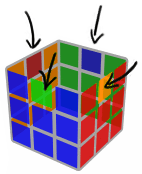
A few days ago, Deadesq (AIC’s first guest blogger) mentioned to me that he was looking for a more efficient solution to the four-headlight situation. By four headlights, he meant the situation in which, after applying the Beginner’s Method PLL corner permutations, you’re left with all four faces having headlights — with no fully solved side face.  As I described in my tutorial, in that situation, the Beginner’s Method requires applying the PLL edge permutation algorithm twice in a row.  Although I can do that quickly, it’s still not as quick as a single permutation. Enter H and Z perms…. Continue reading

The Most Spectacular, Stupendous, Sweeping, Slick, Straightforward Rubik’s Cube Tutorial the Web Has Ever Known (and Likely Ever Will Know) – Part 4 (Completing the Cube)

NOTICE: WORK IN PROGRESS. THIS POST AND OTHER PARTS OF THE TUTORIAL ARE STILL BEING CONCEIVED, WRITTEN, AND SPRUCED UP. YOUR PATIENCE WHILE THE HAMSTERS REST IS APPRECIATED.
Beginner’s Guide
Table of Contents

STEP 4: Permuting the Last Layer (PLL)

The good student you are, you’ve now studied the Cross, First Two Layers, and OLL Beginner’s Method tutorials.  If you followed them closely, your cube should like this.  The bottom face should be all white, the top face should be all yellow, and the first two layers should be solved.  The last layer, indicated in gray, is likely to be a bit jumbled.  (There is a 1/16 chance that the previous OLL step actually solved the cube completely.)

The goal in this last step is to orient (“permute,” in cube-speak) the last layer pieces into the correct positions without disturbing the top face, bottom face, or first two layers. Continue reading