
Backstory — The Force Cube
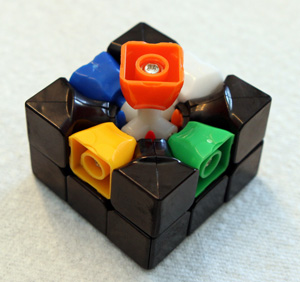 I’ve been cubing for about seven months now, and, in so doing, have gotten four friends to take up cubing. The five of us have spent our fair share of time on amazon.com and comparing notes, and have each come to favor Dayan Zhanchis as our go-to speed cubes. No real surprise there; many consider Zhanchis the gold standard. The surprise is more subtle. Of the three varieties of Zhanchis (black, white, multi-colored unstickered), we each rank them in exactly the same order: first, the unstickered; second, white; third, black. There’s just something “softer,” smoother yet clickier, more controllable about the unstickered cubes. We guessed that the matching preferences were the result of either small differences in the plastics or a shared placebic hallucination.
Slightly confounded, I found validation in this speedsolving.com thread about the “Force Cube.” Turns out another cuber, AL60RI7HMIS7, also had a hankering for stickerless Zhanchis. Realizing that they weren’t competition legal (the piece edges reveal the color of a face pointing away from you), she came up with a clever solution: Buy six stickerless Zhanchis, disassemble, and then reassemble, creating six different Zhanchis — each of a single color of plastic (read: competition-legal), and each made of the stickerless plastic that many some cubers prefer. Those solid colored cubes could then be stickered like any other cube. BRILLIANT! The only rub was that six Zhanchis would generate only one white cube, with five “byproduct” cubes in undesirable colors. Of course, none of the six were black.
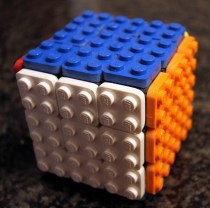 There was no toy I enjoyed more as a kid than my Legos. I remember the exact drawer in which we stored them and have vivid memories of building a two-story house with my Dad, with shutters that we would open and close each morning and evening. In the world before cable TV and the internet and iPads and computers, I had Lego (and Brio) — and that was all I needed.
 adventures in cubing