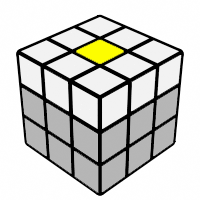
OLL Dot Cases (##1, 2)

dot2_200pxSo, yeah, I’m still cross training, although I don’t expect to harvest any significant improvement for a while. In the meanwhile, I decided to learn a couple more OLLs that seem to crop up frequently — the single dot cases. The two cases (OLLs ##1 and 2 on the speedsolving.com wiki) are mathematically somewhat rare — with their probabilities at 1/108 and 1/54 respectively. That’s the equivalent of a 1-in-36 (or about a 2.8%) chance of having either of these cases arise during a solve. They seem to occur more frequently for me, probably just because not knowing how to one-look them made them more conspicuous.

I don’t usually post about each OLL or PLL I learn. But there seemed to be a dearth of tutorials on these two cases, with the few videos I found online lacking any technique focus or finger-trick explanations. Also, both of these OLLs seemed vulnerable to simplifying alternations to make them more accessible to beginners or novices. Here’s my short video tutorial:
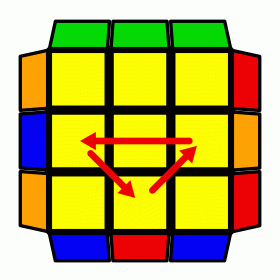
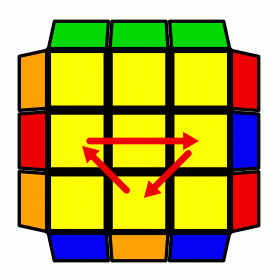
(music: Jacob Fred Jazz Odyssey, “Thelonious Monk is My Grandmother”; cube: Lubix Zhanchi w/ Cube Specialists fitted bright stickers and modded Cubesmith grey stickers for U face)

Continue reading

U Perms (Revisited)

Slow-Motion videos of these algorithms are available here.

U Perms. Round 3. I sort of accidentally learned the U Perm (edge cycling) through the Beginner’s Method and its clunky final algorithm: F2 U(’) R’ L F2 R L’ U(’) F2. Then I started learning PLLs and wrote about the more efficient approaches I had found (now-stricken in the table below). When I did my foozled PLL time attack, that Ua was my fastest with Ub second. But those still involved a lot of moves, and Ub had a sort of clunky flow.

When I learned double M flicks, I started doing Ua with the new M/U algorithm. But I couldn’t get Ub figured out, with my hands mis-positioned for the U’ turns. Then I stumbled onto Anotine Cantin’s video on how to fingertrick Ub. A little awkward at first with the right index finger pulling left to right for U’, but it wound up being pretty easy after a little practice. Here’s my video showing both:

Once I got the finger-tricks figured out, these wound up having a really nice flow. And, in contrast to the older versions, there’s an elegant symmetry to the clockwise and counter-clockwise algorithms.

U PERM (Edge Cycle)

Ua PLL
Counter-Clockwise

M2 U M U2 M’ U M2

(R U’ R U) (R U) (R U’) (R’ U’ R2)

Ub PLL
Clockwise

M2 U’ M U2 M’ U’ M2

(R2 U) (R U R’ U’) (R’ U’) (R’ U R’)

Onward….

2x2s Revisited

I haven’t spent much time at all on 2x2s. I actually think they’re fun puzzles, but just never really got that into them. I basically got a V-Cube 2×2 a month after getting into cubing, landed a 27-second on-video solve on my first try, got a 16-second solve a few days later, and then shelved it.

2×2 OLL GUIDE HERE: DOWNLOAD

When Crazybadcuber posted his excellent 2×2 tutorial (embedded below) the other day, I decided to order a better 2×2 (a WitTwo Type C v1) and try again. The last time I played with a 2×2, I treated it as a 3×3 with no edges. Which, of course, is right. But applying 3×3 algorithms is not very efficient. For example, I used to treat this 2×2 case like this 3×3 case . Of course, the 3×3 algorithm will work. But it takes 12 QTM moves with a couple D layer moves (which I find hard on a 2×2). By contrast, the 2×2-specific an alternate 3×3 algorithm takes only 6 QTM moves — and is crazy easy: an F turn to setup, a Sexy Move, and a F’ to finish. EDIT: The key is that these three are equivalent: . Once you ignore edges, there are multiple 3×3 OLL cases to choose from for each 2×2 OLL case. Continue reading

F2L – Corner Placed, Edge in U

As though quoting Scripture, the entire community seems speaks in one harmonized voice when it comes to F2L:

Learn F2L intuitively. Don’t memorize F2L algorithms.

Yeah, ok. I get the point. Intuitively, it’s not hard to grasp pairing corners and edges and then inserting them. And it’s not hard to see how to do that in many instances — splitting pairs, using empty slots, etc.

But I do contend that certain F2L cases are anything but intuitive. In particular, I found completely non-intuitive the cases in which a corner is inserted (but flipped), with the corresponding edge in the U layer. Indeed, I’ve gotten in the inefficient habit of simply getting the corner into the top layer without regard to where (with a R U R’, for example), and then treating it, ahem, like an intuitive F2L case.

No longer. I’m committed to learning the four cases below. The first one is easy — a Sexy Move plus an easy peasy insertion. But the others are so damn similar that I find it nearly impossible to keep them separated in my head. Any suggestions?

setup pairing insertion
(R U R’ U’) (R U R’)
y’ (R’ U R U’) (R’ U R)
(R U’ R’ U) (R U’ R’)
y’ (R’ U’ R U) (R’ U’ R)

F2L Edge Flip

I just posted last week about some fancy edge insertion techniques I had learned. With those down, I realized that I was missing a good algorithm for addressing edges placed in the correct F2L slot but flipped. I finally came across this one, which works fantastically:

r (R U R’ U’) r’ U2 (R U R U’ R2)

I’ve got it down to about 2 seconds now, as shown in this quick video:

(music: Umphrey’s McGee covering Peter Gabriel’s “Sledgehammer”)

I previously had used (R U’ R’) d (R’ U2 R) U2′ (R’ U R) for edge flips. Continue reading