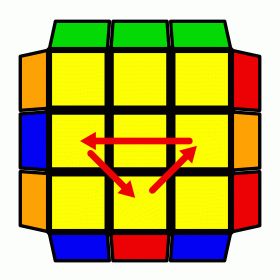
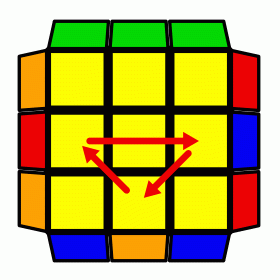
U Perms (Revisited)

Slow-Motion videos of these algorithms are available here.

U Perms. Round 3. I sort of accidentally learned the U Perm (edge cycling) through the Beginner’s Method and its clunky final algorithm: F2 U(’) R’ L F2 R L’ U(’) F2. Then I started learning PLLs and wrote about the more efficient approaches I had found (now-stricken in the table below). When I did my foozled PLL time attack, that Ua was my fastest with Ub second. But those still involved a lot of moves, and Ub had a sort of clunky flow.

When I learned double M flicks, I started doing Ua with the new M/U algorithm. But I couldn’t get Ub figured out, with my hands mis-positioned for the U’ turns. Then I stumbled onto Anotine Cantin’s video on how to fingertrick Ub. A little awkward at first with the right index finger pulling left to right for U’, but it wound up being pretty easy after a little practice. Here’s my video showing both:

Once I got the finger-tricks figured out, these wound up having a really nice flow. And, in contrast to the older versions, there’s an elegant symmetry to the clockwise and counter-clockwise algorithms.

U PERM (Edge Cycle)

Ua PLL
Counter-Clockwise

M2 U M U2 M’ U M2

(R U’ R U) (R U) (R U’) (R’ U’ R2)

Ub PLL
Clockwise

M2 U’ M U2 M’ U’ M2

(R2 U) (R U R’ U’) (R’ U’) (R’ U R’)

Onward….

Feeling Gray

grayA couple months ago I stumbled onto a video by Teal Cubes showing his custom color scheme — blue opposite green, gray opposite white, and pink opposite yellow. The video makes a pretty compelling demonstration that there are better schemes than the 1980s Rubik’s one that most of use without much further thought. That said, I don’t really like pink stickers, and I’m not quite ready to make three color changes at once.

I was curious about the gray U face, though — and I re-stickered a black and a white cube to give it a shot.* The idea is that gray contrasts better against white than does yellow. Obviously, black would contrast even better, but it gets lost on a black cube; gray plays nicely with both black and white plastic. Here’s a video with a further explanation:

Continue reading

43 quintillion possibilities

Short post today, my first from the WordPress iPad app. Sometimes you see something done so well, so elegantly, so cleverly that you can share it with little commentary. Such is the case with Kenneth’s (RedKB) “Why is the Rubik’s Cube So Hard?!?!!” video below. The answer, of course, is that there are 43 quintillion possible cubie combinations on a 3×3 cube, only one of which is “solved.” But 43 quintillion is impossibly hard to understand. Until now:

Kenneth also has a follow up episode on the probabilities surrounding a 7×7, with conclusions that are hard to believe.

This makes me want to do a post on the math behind 43 quintillion. Soon….

39-Second Aof5 entry, analysis (cyoubx/mitchell lane competition)

Competing? Really?

golf-swing-analysisYou don’t skip the company’s annual golf tournament because you’re a double-bogey golfer. You go, drink a few beers, have a good time, and learn a thing or two from the guys who live on the course. At least that’s what I do.

And, metaphorically, that’s what I did when I decided to submit an entry into an online competition administered by cyoubx and Mitchell Lane. They provided scrambles for several events (2×2, 3×3, 4×4, pyraminx) and invited people to “compete” by submitting video responses showing their solves. It would be based on the honor system (no way to prevent people from filming themselves multiple times and submitting only their best), and there would be no prizes. The express purpose was “to ‘meet’ other cubers,” “to encourage personal improvement,” and to strengten “a sense of community” among cubers.

I knew there was zero chance I could win this thing, averaging around 42 seconds (with my better solves in the mid-thirties). But I dug the concept and the chance to try something different as part of the community. Minimally, like folks who film their golf swing for analysis, I figured that I could learn something about my technique.

Video Submission, Results

Here is the 3×3 video I submitted, with a best solve of 37 seconds and an average of five of 39 seconds I realize that the edits between each solve give the appearance of multiple attempts. And there were. But not the cheating of multiple solve attempts; worse, it was multiple scramble attempts!?! Half-way through each of the scrambles, I caught myself reversing (or at least worrying that I had reversed) the inverse/non-inverses for Ds, Ls, and Bs. So I had to keep starting over to make sure I got each scramble right. Trust me, if I were going to cheat, I would have submitted better solves without glaring mistakes!?!

Continue reading

crystal cube hack – part 2

hacked crystal cubeI wrote last week in Part 1 of this post about hacking, so to speak, a Ghosthand Crystal Cube. As detailed in that post, I wired past the motion sensor and on-board IC that caused the irritating and impractical blinking. That forced the cube into a constant-on state once I connected two leads that I had temporarily extended through the core for testing.

As described below, I solved that problem with a switch inside the core that could be reached with a paper clip. Here is a video of the final result, showing the cube powering on/off and a sample solve in the pitch dark. It’s not a speed-cube, and it is prone to pops and lock-ups, so I solved at a casual 55-second pace.

Continue reading