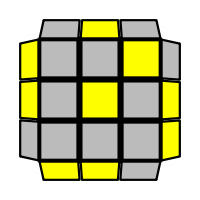
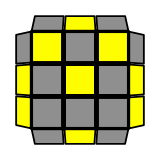
Mouse OLLs (##3, 4)

The Mouse OLLs (##3, 4) are hard. Not so much their execution (certainly the Sexy Move variants aren’t all that bad), but orientation. Where does that corner go? Top-right? Bottom left? And what about that side with just the un-oriented edge? Which is Mouse and which is Anti-?

Having concentrated on these OLLs quite a bit, I now no longer mind them. Here’s a simple table and video tutorial — its soundtrack a tribute to Lou Reed, RIP — followed after the jump by further explanation.

OLL 3 OLL 4 ORIENTATION
SEXY-BASED f (R U R’ U’) f’ (U’)
F (R U R’ U’) F’
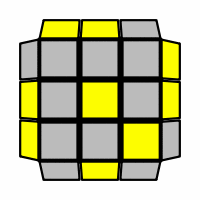
oll3-sexy
f (R U R’ U’) f’ (U)
F (R U R’ U’) F’

oll4-sexy
oriented corner:
R layer

edge-only face:
F/B layers (not L/R)

SUNE-BASED M (R U R’ U) Rw
U2 Rw’ U M’

oll3-sune
M U’ Rw U2
Rw’ (U’ R U’ R’) M’

oll4-sune
oriented corner:
F layer

edge-only face:
L/R layers (not F/B)

(music: in tribute to Lou Reed, Velvet Underground’s “Rock And Roll” performed by Phish on 8.5.11; cubes: white Weilong with Cube Specialists fitted Bright+ stickers, black Zhanchi with Cubicle full-bright stickers)

Continue reading

Parity or: How I Learned to Stop Worrying and Love the 4×4

After painstakingly modding my Shengshou v4s a couple months ago (mod post coming soon), my interest in 4x4s has waxed and waned. On the one hand, I find it a welcome and more challenging distraction from 3x3s; on the other hand, those damn parity algorithms!?! I have finally committed them to muscle memory and am now trotting along at a 2:20 average using the Yau variation of the reduction method. (For more on Yau, and especially the cross-on-right variation that I find easier, check out Cyoubx’ really good Yau intro video.)

For months, parity was my albatross. I finally conquered it, so to speak, not only by finding and learning algorithms that worked for me, but also my learning about the root causes of parity. This was by far my deepest dive into puzzle theory and its associated patois. Keep reading past the jump for much more on the types of cube parity, what causes each, and, most importantly, what we really mean when we sloppily say that a cube has “parity.”

PARITY ALGORITHMS

If you’re just here for the algorithms, look no further:

OLL Parity
4x4-oll-parity

[1] Rw U2 x Rw U2 Rw U2 Rw’ U2 Lw U2
Rw’ U2 Rw U2 Rw’ U2 Rw’

[2] (Rw Lw) U2 Lw’ U2 Rw’ U2′ x’ U2 Rw’ U2′ Rw U2 Rw’ U2′ Rw2 U2

PLL Parity
4x4-pll-parity

Uw2 Rw2 U2 r2 U2 Rw2 Uw2

Here’s a (now muted due to copyright claims) video showing each:

(music: Bob Dylan, “Subterranean Homesick Blues; cubes: Konsta+Florian modded Shengshou v4s with Cube Specialists Bright+ modded stickers)

Continue reading

More OLL Dot Cases (##18-20)

Generally, I find the OLL “dot” cases frustrating — there are a bunch of them, they’re hard to identify/distinguish quickly, and their algorithms are long. A few months ago, I worked on a couple OLL dot cases that I had previously two-looked. Those came rather easily. Then I got side-tracked by the Megaminx, 4×4 modding, and PLL time attacks.

I decided to work on more OLLs last week, after stumbling onto Ottozing’s very good Cubing World video showing all of the dot cases. Specifically, these three:

OLL #18
(Crown)

oll-18

(r U R’ U) (R U2′) r2′
(U’ R U’ R’) U2 r

OLL #19
(Bunny)

oll-19

M U (R U R’ U’)
M’ (R’ F R F’)

OLL #20
(Checkerboard)

oll-20

(r U R’ U’) (L2 l2′) (U R U’ R’) U’ M’

Continue reading

Megaminx Beginner’s Walkthrough, ECE Trio Tutorial (no last layer)

I’ve been on a Megaminx kick for the past 10 days. After posting that 10-minute (plus) non-last-layer solve, I practiced a bit more and finally did learn the last layer (beginners’ tutorial coming soon). I’m down to about 6 minutes now for a full solve. With one exception that I’ll point to in my upcoming last layer post, I couldn’t find many good Megaminx tutorials online. Instead, I kept bumping into statements that solving a Megaminx is just like solving a 3×3 — but with a bunch more F2L steps. Yeah, that is basically right. But not entirely.

On a cube there are just 4 F2L slots. Except for some incremental efficiency gains, there’s really no magic to the order in which you fill those slots. On a Megaminx, order does matter — at least, I found that certain face/slot orders flows more smoothly, with a lot less potential for accidentally destroying already-solved portions.

I also found that there will always be one tricky V-shaped slot formed by an edge-corner-edge (ECE) trio. In the end, it turns out that’s it’s not that hard to form and insert the trio without breaking up the solved neighboring faces. I just wish someone would have created a clear tutorial one it, since it’s not entirely intuitive. Having figured out a technique that worked well for me, I decided to do a quick walk-thru video showing the face/slot order I use and then explaining the way I fill that ECE trio:

This is a beginner doing a beginner’s work; there’s some inefficiency and excess hunting throughout. Continue reading

V Perm (Revisited)

v permI remember learning the V Perm early in my PLL progress and being quite proud of myself. I even wrote this dedicated post containing a video showing my unimpressively slow execution. Unfortunately, the execution never got that much more fluid. Although it was an average speed perm for me when I did my (kinda sorta) PLL attack, it always was one of my clunkier ones.

Last weekend, jskyler91 posted a new Cubing World video showing a “non-standard” V Perm execution based on this algorithm:

z D’ R2′ D (R2 U R’) D’ (R U’) (R U R’) D (R U’) z’

No awkward re-grips and much smoother than the traditional approach. He bemoaned the z rotations; I was intimidated by all the D layer moves. Still, the fact that he could sub-1 the perm led me to believe that I could do it in 2. As this video shows, I’m close:

(music: Eldar Djangirov interpreting “Cool” (West Side Story); cube: Lubix Zhanchi w/ Cube Specialists fitted bright stickers and modded Cubesmith grey stickers for U face)

Continue reading