more OLLs (corners correct / edges flipped)

Slowly, I’ve been chipping away at new algorithms and permutations. Last week I learned a faster edge cycle technique (both directions), and I’ll post about that soon. This weekend, I learned more OLLs — the three with the corners correct but edges flipped. I’m not great at memorizing, but these are starting to come fairly easily. More muscle memory than memorization, I suppose. Here’s a quick video with the three:

And here are the algorithms I use: Continue reading
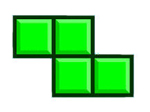
OLL 6 (Sidewinder / Tetris)

I feel like I’m starting to hit a new groove. After mastering the Beginner’s Method a couple months ago, I’ve slowly embraced more complicated techniques (read: time-savers). First, it was the advanced cross technique, which I learned quickly but at which I’m still slower than I ought to be. Then it was a month of intuitive F2L. I’ve got that mostly down, with a couple non-intuitive cases still a challenge. Lately, I’ve been jazzed to learn a few more OLL/PLL algorithms. Each expands the toolbox and introduces more efficiency. Last week, it was H and Z PLL perms. This week, it’s OLL 6 (aka, The Sidewinder).
OLL #6
(Sidewinder / Tetris )

(R’ F) (R B’) (R’ F’) (R B)

Continue reading

learning the H and Z perms

A few days ago, Deadesq (AIC’s first guest blogger) mentioned to me that he was looking for a more efficient solution to the four-headlight situation. By four headlights, he meant the situation in which, after applying the Beginner’s Method PLL corner permutations, you’re left with all four faces having headlights — with no fully solved side face.  As I described in my tutorial, in that situation, the Beginner’s Method requires applying the PLL edge permutation algorithm twice in a row.  Although I can do that quickly, it’s still not as quick as a single permutation. Enter H and Z perms…. Continue reading

Tough F2L Cases

PSA: This is a very old post, written just as I had begun to tackle F2L. Although my F2L is now much better, these cases remain hard. I’ve addressed these cases a few times since, with more robust analysis and improved algs — e.g., here, here, and here.

So, I’ve been working hard on F2L. Refusing to memorize algorithms, and heeding expert advice, I’ve concentrated on learning it “intuitively” or “organically.” While most of the cases feel instinctive at this point, there are a handful whose solution feels slightly less intuitive. This tutorial is a sort of personal dumping ground and cheat sheet for the cases I find toughest. I’ll add cases as they come up for me.

The basic solutions come from Badmephisto’s F2L cheat sheet, with some small tweaks to personalize them into my solving technique. As always, the visual diagrams come from Conrad Rider’s fantastic Visual Cube generator. Continue reading

The Most Spectacular, Stupendous, Sweeping, Slick, Straightforward Rubik’s Cube Tutorial the Web Has Ever Known (and Likely Ever Will Know) – Part 4 (Completing the Cube)

NOTICE: WORK IN PROGRESS. THIS POST AND OTHER PARTS OF THE TUTORIAL ARE STILL BEING CONCEIVED, WRITTEN, AND SPRUCED UP. YOUR PATIENCE WHILE THE HAMSTERS REST IS APPRECIATED.
Beginner’s Guide
Table of Contents

STEP 4: Permuting the Last Layer (PLL)

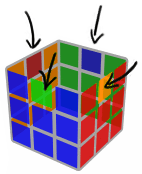
The good student you are, you’ve now studied the Cross, First Two Layers, and OLL Beginner’s Method tutorials.  If you followed them closely, your cube should like this.  The bottom face should be all white, the top face should be all yellow, and the first two layers should be solved.  The last layer, indicated in gray, is likely to be a bit jumbled.  (There is a 1/16 chance that the previous OLL step actually solved the cube completely.)

The goal in this last step is to orient (“permute,” in cube-speak) the last layer pieces into the correct positions without disturbing the top face, bottom face, or first two layers. Continue reading