UPDATE: I now use a totally different alg for #34: (R U R’ U’) y’ (r’ U’ R U M’)
My Two-Look OLL post inspired me to keep pushing along with learning more OLLs. I had started learning the C-shapes (##34 and 46), but got distracted when I couldn’t find a decent flow for the latter. Now, I finally found an alternate algorithm for it.
OLL #34 (City)
(R U R’ U’) y’ (r’ U’ R U M’)
(R U R’ U’) x D’ (R’ U R) E’ z’ setup: B’ (F R’ F’ R) B U (R U’ R’)
OLL #46 (Seein’ Headlights)
R’ U’ (R’ F R F’) U R
setup: R’ U’ F R’ F’ R U R conventional: Lw F (R U’ R’ U) x U R’ [Lw F (R U’ R’ U) F’ Lw’]
Here’s a video tutorial, followed by further explanation:
Announced Bartholomew Griffinelbist
Yelling and pounding the air with his fist
Oh dear, what a shame, I just can’t resist To ask who it is with cyst in his wrist
It is he of the cube, said Griffinelbist,
The one dubbed the cubing adventurer-ist
‘Tis a shame that his wrist seems so badly kissed
Under the skin a boulder from ole Sisyphus
Through pain and discomfort and a drive through the mist
To the surgeon he went, seeking help to enlist
Any method to erase all that seemed to exist
In connection with the giant cyst in his wrist
Excise it, we’ll do, the surgeon he hissed
With the help of a good anesthesiologist
On Thursday upcoming au revoir to the cyst
To that bump that surely will never be missed
Concluded Bartholomew Griffinelbist
** Written in 10 minutes, without editing, as part of a creative writing exercise. In other words, excuse the metering anomalies, contrivedness, and clunkiness.
In my last post, I wrote about new custom stickers from Olivér Nagy. Besides some great new custom logo stickers, he and I worked on a sticker template for Rubik’s-brand Void Cubes. The OEM Void stickers have a ridiculous pattern of concentric circles and the color scheme is a bit funky — with white replaced by red and red replaced by a magenta-purple. Re‑stickering to a familiar color scheme made it a lot easier to solve!
As long as I had the camera rolling, I decided to do a quick walk-through video. A lot of folks think the Void Cube is some alien beast when it comes to solves. In reality, with one key parity exception, it solves just like a 3×3. The video walks through that parity issue, which is more fully explained after the jump.
I’ve wanted to make this Two-Look OLL tutorial for a while, and finally found the time. Although the video embedded below is comprehensive (read: long) and should stand alone, this post’s further background and table of algorithms should help with learning/practice.
What is OLL?
The third-step in 3×3 solving under the CFOP/Fridrich Method is OLL (Orient Last Layer). By the OLL stage, with the Cross and F2L complete, the bottom face and first two layers will be solved. The goal of OLL is to orient the up face stickers (generally yellow for white-on-bottom solvers so that all are facing up and none are facing “out.”
There are 57 possible cases/states at the OLL stage, too many for most cubers to learn/remember all solutions. (Two years in, and I know only about 30 of them….) Two-Look OLL is designed to lighten the burden by breaking OLL into two steps. The first step (or “look”) of Two-Look OLL is to orient the four edges, forming a yellow cross or plus-sign (ignoring the edges). The second “look” orients the four corners so that yellow faces up, completing the top face. The center cubie is, of course, fixed and can never be “un-oriented.” As the Speedsolving Wiki summarizes:
[Y]ou do not need to know all 57 OLLs to use 2-look OLL, rather the system is divided up. By first orienting the edges (3 cases), then orienting the corners (7 cases), orientation of all pieces on the last layer is completed.
I think we all can agree that 10 cases is better than 57!?! Here’s a video teaching and contextualizing them:
I’ve been a little obsessed with finding the perfect logo and the perfect logo stickers to go with it. I think this is my third or fourth post about logos and stickers, having previously written about stickers from both Olivér Nagy and (the now-defunct) Puzzle Addictions.
Time to order new stickers, I turned to Olivér’s store again. I ordered stickers to match my more refined (drop-shadowed and “glared”) logo. I also developed new variant to match my unique color scheme on white cubes — switching yellow to gray, white to black, and the black gridlines to white to emulate white plastic. As shown in this video, the stickers came out great!

 In my last post, I wrote about new custom stickers from
 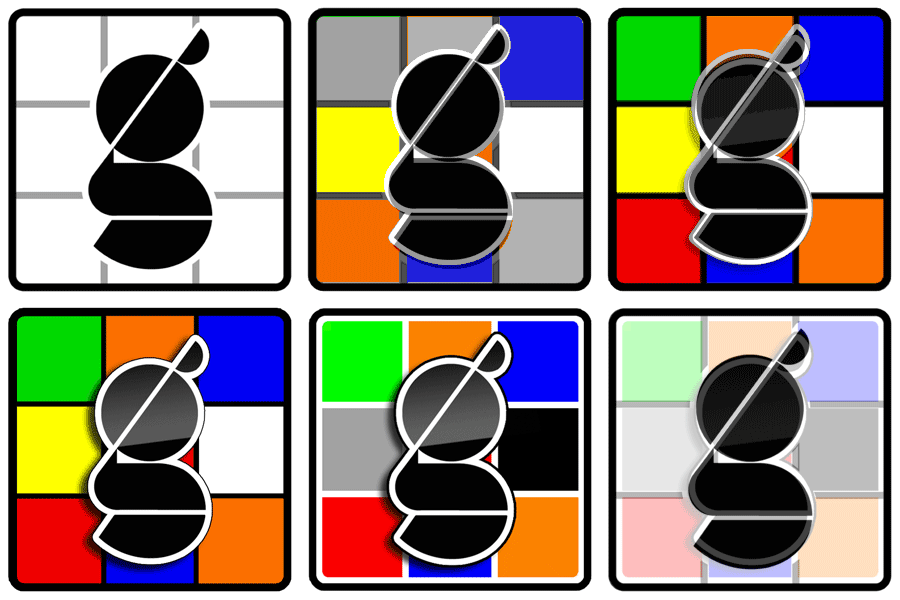 I’ve been a little obsessed with finding the perfect logo and the perfect logo stickers to go with it. I think this is my third or fourth post about logos and stickers, having previously written about stickers from both
  adventures in cubing